 |
|
|
 Editorials | At Issue | June 2006 Editorials | At Issue | June 2006 
A Call to Investigate the 2004 US Election
 Steven F. Freeman & Joel Bleifuss - Boston Globe Steven F. Freeman & Joel Bleifuss - Boston Globe
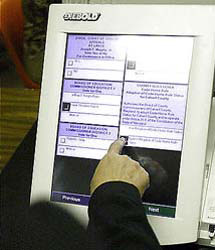
| | A Calvert County, Maryland, elections official demonstrates how an electronic voting machine works. A team of cybersecurity experts concluded in a report issued yesterday that it would take only one person - with a sophisticated technical knowledge and timely access to the software that runs the voting machines - to change the outcome of an election. The report concluded that the three major electronic voting systems in use have significant security and reliability vulnerabilities. (Mark Gail/The Washington Post) |
We've all heard the story. Nov. 2, 2004, was shaping up as a day of celebration for Democrats. The exit polls were predicting a victory for Senator John Kerry. Many Americans, including most political observers, sat down to watch the evening television coverage convinced that Kerry would be the next president.
But the counts that were being reported on TV bore little resemblance to the exit poll projections. In key state after state, tallies differed significantly from the projections. In every case, that shift favored President George W. Bush. Nationwide, exit polls projected a 51 to 48 percent Kerry victory, the mirror image of Bush's 51 to 48 percent win. But the exit poll discrepancy is not the only cause for concern.
In Ohio, Secretary of State Kenneth Blackwell, the Ohio co-chairman of the 2004 Bush/Cheney Campaign, borrowed a chapter from Secretary of State Katharine Harris's Florida 2000 playbook. Like Harris, he used the power of his office to affect turnout and thwart voters in heavily Democratic areas. Vote suppression and electoral irregularities in Ohio have been documented, first in January 2005 by Democrats on the House Judiciary Committee, and in June 2005 by the Democratic National Committee, which found, in the words of DNC Chairman Howard Dean: "More than a quarter of all Ohio voters reported problems with their voting experience."
Election Day 2004 also saw the advent of a congressional mandate under the Help America Vote Act to replace punch-card systems with new, unproven technologies. In that election, 64 percent of Americans voted on direct recorded electronic voting machines or optical-scan systems, both of which are vulnerable to hacking or programming fraud. According to a September 2005 General Accountability Office investigation, such systems contained flaws that "could allow unauthorized personnel to disrupt operations or modify data and programs that are critical to ... the integrity of the voting process."
A reasonable person could thus argue that a well-conducted exit poll that confirmed the official count would be about the only reason we would have to believe the results of such an election. Without an audit or a recount to verify the official count, those of us who suspect that the presidential election was stolen do so based on the information now available.
In the days after the election, the media largely ignored this exit poll discrepancy. When it was mentioned, it was only to report that the exit polls - based on a confidential, 25-question written survey of 114,559 voters in 1,480 precincts - were flawed. The discrepancy, however, was real and beyond the statistical margin of error. On that, there is widespread agreement. What is still being debated is only the reasons for the discrepancy.
In January 2005, on the eve of Bush's inauguration, the two men who conducted the 2004 exit poll, Warren Mitofsky and Joe Lenski, released their promised explanation. Their report began: "The inaccuracies in the exit-poll estimates were not due to the sample selection of the polling locations at which the exit polls were conducted." In other words, the precincts they sampled were representative of the nation, so the discrepancy was not the result of choosing unrepresentative precincts.
The data they released allows researchers to correlate voter characteristics (race, age, sex, etc.) with voting preferences - but it was not the data that identified specific exit poll results with specific precincts. That data remains the property of the media consortium (ABC, NBC, CBS, Fox, CNN, and the AP) that commissioned the polls. No one has provided a coherent account of how polling error could explain the discrepancy. We have only the pollsters' blithe assertion that Kerry voters must have disproportionately participated in the polls. Yet the available state-level data contradicts the pollsters' explanation, also termed the "reluctant Bush respondent" theory. The data does show that key variables - racial makeup of a state, partisan control of governorships, whether a state is a swing state, and reports of Election Day complaints - all correlate with the magnitude of the poll discrepancy.
The report also indicated that for rural and small-town precincts - the only ones where comparable data does exist - the difference between the exit poll results and the official count is three times greater in precincts where voters used machines than in precincts using paper ballots alone. If we had access to the withheld precinct-level data, we would be able to investigate whether the size of the exit poll discrepancy correlates with the voting technology used.
For these reasons and more, it is imperative that our newspapers of record as well as our governmental oversight bodies now investigate the question people continue to ask: Was the 2004 election stolen?
Joel Bleifuss and Steven F. Freeman are authors of the book Was the 2004 Presidential Election Stolen?
A Single Person Could Swing an Election
Zachary A. Goldfarb - The Washington Post
Electronic systems' weaknesses may be countered with audits, report suggests.
To determine what it would take to hack a U.S. election, a team of cybersecurity experts turned to a fictional battleground state called Pennasota and a fictional gubernatorial race between Tom Jefferson and Johnny Adams. It's the year 2007, and the state uses electronic voting machines.
Jefferson was forecast to win the race by about 80,000 votes, or 2.3 percent of the vote. Adams's conspirators thought, "How easily can we manipulate the election results?"
The experts thought about all the ways to do it. And they concluded in a report issued yesterday that it would take only one person, with a sophisticated technical knowledge and timely access to the software that runs the voting machines, to change the outcome.
The report, which was unveiled at a Capitol Hill news conference by New York University's Brennan Center for Justice and billed as the most authoritative to date, tackles some of the most contentious questions about the security of electronic voting.
The report concluded that the three major electronic voting systems in use have significant security and reliability vulnerabilities. But it added that most of these vulnerabilities can be overcome by auditing printed voting records to spot irregularities. And while 26 states require paper records of votes, fewer than half of those require regular audits.
"With electronic voting systems, there are certain attacks that can reach enough voting machines ... that you could affect the outcome of the statewide election," said Lawrence D. Norden, associate counsel of the Brennan Center.
With billions of dollars of support from the federal government, states have replaced outdated voting machines in recent years with optical scan ballot and touch-screen machines. Activists, including prominent computer scientists, have complained for years that these machines are not secure against tampering. But electronic voting machines are also much easier to use for disabled people and those who do not speak English.
Voting machine vendors have dismissed many of the concerns, saying they are theoretical and do not reflect the real-life experience of running elections, such as how machines are kept in a secure environment.
"It just isn't the piece of equipment," said David Bear, a spokesman for Diebold Election Systems, one of the country's largest vendors. "It's all the elements of an election environment that make for a secure election."
"This report is based on speculation rather than an examination of the record. To date, voting systems have not been successfully attacked in a live election," said Bob Cohen, a spokesman for the Election Technology Council, a voting machine vendors' trade group. "The purported vulnerabilities presented in this study, while interesting in theory, would be extremely difficult to exploit."
At yesterday's news conference, the push for more secure electronic voting machines, which has been popular largely on the left side of the political spectrum since the contested outcome of the 2000 presidential election in Florida, picked up some high-profile support from the other side.
Republican Reps. Tom Cole (Okla.) and Thomas M. Davis III (Va.), chairman of the House Government Reform Committee, joined Rep. Rush D. Holt (D-N.J.) in calling for a law that would set strict requirements for electronic voting machines. Howard Schmidt, former chief of security at Microsoft and President Bush's former cybersecurity adviser, also endorsed the Brennan report.
"It's not a question of 'if,' it's a question of 'when,' " Davis said of an attempt to manipulate election results. |
| |
|


 Vallarta Weddings
 Tell a Friend
 Site Map
 Print this Page
 Email Us