 |
|
|
 Editorials | At Issue | June 2006 Editorials | At Issue | June 2006 
Mexico Divided As Ever After TV Election Debate
 Alistair Bell - Reuters Alistair Bell - Reuters
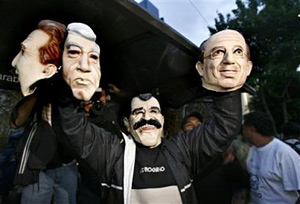
| | A man wearing a mask of Mexican President Vicente Fox sells masks of Mexican presidential candidates outside of the site where the second and last presidential debate was being held in Mexico City. All five of Mexico's presidential candidates took part in the debate, but most eyes were on conservative Felipe Calderon and leftist Andres Manuel Lopez Obrador. (AP/Dario Lopez-Mills) |
Communist flag-waving, a combative television debate and a shooting have turned up the heat in a nasty presidential campaign that has polarized Mexican politics but failed so far to point to a clear winner.
The two main candidates in the race to replace President Vicente Fox on July 2 are in a dead heat in opinion polls and a live debate on Tuesday night appeared to do little to change that.
Many newspapers on Wednesday declared Felipe Calderon the winner of the face-to-face contest with leftist Andres Manuel Lopez Obrador. But the latter scored points for keeping his famous temper under control and sticking to the line that his plans to help Mexico's millions of poor are nothing radical.
Some 10,000 of Lopez Obrador's supporters who gathered in the capital's main square or Zocalo to watch the debate on two big screens hurled insults and jeers whenever Calderon spoke.
Two campaigners on stilts waved the red hammer and sickle communist flag to cheers from the crowd.
Analysts were divided over who had won the debate.
Calderon, a former energy minister, frequently called his rival a liar and said: "The project you represent is a danger to Mexico because of the threat of debt and economic crisis."
Third-placed candidate Roberto Madrazo told Reuters on Wednesday the mud-slinging was getting out of hand.
"I am very worried about the polarization that has happened in the electoral race. It's very regrettable that an intolerant, radical right that is inexpert in matters of state is taking on a very violent left."
VIOLENCE RESURFACES
Fears of a return to the endemic political violence of the mid-1990s were rekindled on Tuesday when gunmen shot at the family of a jailed businessman who had threatened to release videos damaging to Lopez Obrador. No one was injured.
Lopez Obrador commands fierce loyalty from supporters, as well as fear among the rich who call him a populist who will ruin Mexico's economy.
"He's the one who understands the poor. There's no reason for Mexico to have such poverty," follower Joel Iniesta, 68, said in the Zocalo.
Mexican stocks fell by 2.05 percent on Wednesday, hurt by election uncertainty and higher U.S. interest rates.
Party leaders met at a luxury hotel to discuss forging a "civility pact" between them to allay tensions.
"It's going to be very useful if we reach an agreement between the parties. I know the party leaderships are working on that, which pleases me," Calderon said.
Electoral authorities have had to ban libelous television spots by the two front-runners.
Aggressive ads by Calderon, like one comparing Lopez Obrador to populist Venezuelan President Hugo Chavez, prompted the leftist to respond with harsh rhetoric.
Violence has shadowed the election campaign, which began in January. Police shot dead two striking steelworkers in April and a 14-year-old boy died in a peasant riot near the capital.
Mexico only achieved full democracy in 2000 when Fox ended seven decades of single-party rule and analysts worry that institutions are still fragile.
Polls show that if either of the two main candidates wins, he will still have to work with a congress where the opposition is strong.
"The seeds of deep political divisiveness planted during the campaign could present grave challenges for the incoming government," the Washington-based Council On Hemispheric Affairs, think tank said in a research note.
(Additional reporting by Greg Brosnan, Miguel Angel Gutierrez and Catherine Bremer) |
| |
|


 Vallarta Weddings
 Tell a Friend
 Site Map
 Print this Page
 Email Us