 |
|
|
 Editorials | At Issue | June 2006 Editorials | At Issue | June 2006 
Mexican Election Could Give US a Leftist Neighbor
 Patrick Moser - AFP Patrick Moser - AFP
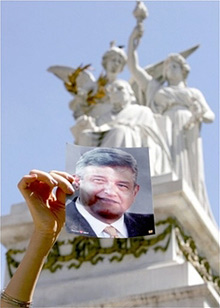
| | A supporter of the presidential candidate of the leftist Democratic Revolution Party (PRD) Andres Manuel Lopez Obrador, shows his picture during a rally at the "Benito Juarez Monument" in Mexico City. Over 71 million Mexicans are eligible to vote in a hotly contested presidential election on Sunday. (AFP/Alfredo Estrella) |
Mexicans will vote this Sunday in elections that could dash Washington's hopes of seeing Latin America's leftward trend reversed, with a leftist former mayor holding a thin lead over his conservative rival.
Opinion polls give Andres Manuel Lopez Obrador, 52, a lead of two to five points over conservative Felipe Calderon, 43, who himself has a slight advantage over Roberto Madrazo, of the once mighty Institutional Revolutionary Party (PRI).
Highly popular as Mexico City's mayor from 2000 to 2005, Lopez Obrador has attracted widespread support among the millions of Mexicans who struggle to survive in a country where about half of the population of 107 million lives in poverty.
But many better-off Mexicans and foreign investors worry about the populist rhetoric of the Democratic Revolution Party (PRD) candidate.
Calderon, of the ruling National Action Party (PAN), claims the former mayor would bankrupt the country with heavy government spending, and likens him to Hugo Chavez, Venezuela's staunchly anti-US leader. Lopez Obrador rejects the comparison, and campaign aides insist he is far closer to moderate leftists such as Brazil's Luiz Inacio Lula da Silva and Chile's Michelle Bachelet.
Either way, Washington is keeping a close eye on the election, evidently hoping it would reverse the trend that brought several leftists to power in Latin America in recent years.
All three leading candidates would be likely to continue cooperating with the United States on border security and drug trafficking, but analysts say Calderon would invest more financial resources and political capital in these areas.
Lopez Obrador insists he would maintain good relations with Washington. At the same time, he says Mexico should not be a US "puppet" and wants parts of the wide-ranging North American Free Trade Agreement (NAFTA) to be renegotiated to better serve Mexicans' interests.
Lopez Obrador, Calderon and Madrazo, as well as the other two candidates who lag far behind, have pledged to boost economic growth in order to tackle pressing social issues and create jobs that would stanch the flow of migrants to the United States.
Calderon, a staunchly conservative former energy minister, says he would achieve this by encouraging foreign investment, allowing private partnerships in the state-run oil sector and slashing corporate taxes.
The economy was stagnant for much of Fox's government but has now picked up, with soaring oil prices helping fuel economic growth, which rose to 5.5 percent in the first quarter of the year.
Lopez Obrador says the wealth is not trickling down to depressed rural areas or to the millions of urban poor in Mexico, forcing people to risk their lives to illegally cross the border into the United States. About 10 million Mexicans live in the United States, where authorities have stepped up measures to halt illegal immigration.
Lopez Obrador, widely known by his initials AMLO, wants the state to play a stronger role in the economy and advocates new infrastructure projects he says would rapidly create jobs. He has pledged a 20 percent salary increase for low-paid workers.
Calderon, for his part, has pledged to maintain economic stability by retaining the government's austere spending programs and has said he would create alliances to ensure passage of reforms Fox had been unable to push through for want of congressional support.
The PAN suffered a series of electoral blows in 2004 and 2005, when it was defeated in a string of state and local elections by the PRI, whose 71-year rule ended when Fox won the 2000 election.
The PRI governs 17 of the country's 32 states and is currently the main party in Congress. Voters will renew the Congress on Sunday, but none of the parties is likely to win an outright majority. |
| |
|


 Vallarta Weddings
 Tell a Friend
 Site Map
 Print this Page
 Email Us