 |
|
|
 Editorials | At Issue | June 2006 Editorials | At Issue | June 2006 
Mexico's PRI Dinosaur Hurt, Still Dangerous
 Alistair Bell - Reuters Alistair Bell - Reuters
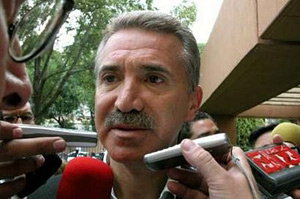
| | Mexican presidential candidate Roberto Madrazo of the Institutional Revolutionary Party, trailing in third place just a month before Mexico's presidential race, finds himself struggling to hold Mexico's once-all powerful ruling party together as prominent leaders flee and endorse either the left or the right candidates. (Reuters) |
Hit by infighting, a dark history and a weak candidate, the party that ruled Mexico for most of last century has put its faith in hard core supporters to help avoid its worst presidential election ever.
The Institutional Revolutionary Party, or PRI, is in third place in opinion polls but boasts an efficient party machinery that might just give its candidate Roberto Madrazo a chance when Mexico votes on July 2.
The red, green and white emblem of the PRI, which ruled longer than any party in the world except the Soviet Communists, is painted on walls and huts in even the most remote village - a testimony to the party's nationwide reach after a 71-year rule that ended in 2000.
A large network of party workers gets supporters to voting booths in poor areas, traditionally taking them by bus and tempting them with a sandwich and soft drink.
In Chimalhuacan, a poverty-belt town east of Mexico City, the PRI is fighting to hold back a tide of support for leftist Andres Manuel Lopez Obrador, whose party swept the surrounding area in municipal elections in March.
The PRI, which has always ruled the town, sponsors free-style wrestling shows and street soccer leagues to keep voters' in the fold. Party workers are particularly proud of neighborhood fiestas held to celebrate Mother's Day this May.
"We organized raffles and gave out little presents," said Inocencio Ibarra, party head in Chimalhuacan. The PRI has 80 affiliated groups in the town, from a lawyers' organization to musicians' bodies and a market vendors' association.
CANDIDATE STRUGGLING
Often accused of being untrustworthy, Madrazo is lagging behind Lopez Obrador and conservative Felipe Calderon who are tied for first place in opinion polls.
The PRI hopeful received a lift last week when a Milenio newspaper survey put him only three points off the lead.
"It's still a two-way race, however you can't completely rule out the one in third place," said Roy Campos of Consulta Mitofsky poll firm.
The party has been hit by internal challenges to Madrazo, who has alienated top party figures and voters.
Sen. Genaro Borrego, who has complained about Madrazo's leadership, quit on Tuesday after 30 years in the party. He was facing sanction for making comments favorable to Calderon.
Another senator, Manuel Bartlett, a PRI patriarch known for his staunch opposition to energy reforms, may be expelled for suggesting that voters back Lopez Obrador.
The PRI, caricatured in the press as a dinosaur, governs 17 of Mexico's 31 states and is the main party in Congress. It has blocked economic reforms proposed by President Vicente Fox, who defeated it in the 2000 election.
The PRI candidate has never finished as low as third in a presidential election.
"Without doubt the PRI at local and regional level is not finished at all. I think Madrazo is betting on that," political analyst Marcela Bobadilla said.
A low turnout on July 2 would help Madrazo because of the PRI's ability to get voters to the polls.
"In a war, winning in the air is not enough, you need to put troops on the ground. The PRI has ground troops," said pollster Maria de las Heras.
The PRI has still been unable to shake off a reputation for corruption and many voters say they will no longer be seduced by its electoral stunts.
"I've seen all their tricks," said Pedro Siles, 75, who heads a peasants' group linked to the PRI in Chimalhuacan who says he will vote for Calderon this time. "The PRI is garbage," he said.
The PRI Meltdown is Polarizing Mexican Campaign
Carlos Luken - MexiData.info
It was expected that Mexico’s major political establishment, the Institutional Revolutionary Party (PRI) would prevail and continue being a powerhouse forever. But after loosing its seventy-year-old power grip to then National Action Party (PAN) candidate Vicente Fox in the 2000 presidential election it has all but crumbled into a flimsy reminiscence of what it once was.
In 2003 there were expectations of a PRI renaissance as the once invincible political machine showed resilience and rebounded during that year’s congressional and state elections, nearly capturing the house majority and most government seats it contested. Those victories had many analysts wondering and forecasting the return of the political dinosaurs. But those glory days soon faded.
Now the once unbeatable party has seemingly self destructed, and gone from being one of the country’s three major political forces to an “also-ran” contender.
Things began unraveling with the PRI’s internal selection process for the 2006 presidential candidacy. Many thought that then party president Roberto Madrazo’s self-inclusion on the list stacked the deck in his favor; others, including many PRI governors, audaciously rejected him as a symbol of a heavy-handed corrupt PRI that in their opinions should have remained in Mexico’s past, and like MacArthur’s old soldier just fade away.
But Madrazo was determined and proved to be too tough. In spite of heavy opposition from party notables, he managed to manipulate and win the party convention and was declared the official PRI candidate. Since then he has struggled with an ongoing mutiny in order to avoid party ruptures into several splinter groups.
Madrazo’s consistently poor poll numbers placed him third behind PAN’s Felipe Calderon and Democratic Revolutionary Party (PRD) candidate Andre Manuel Lopez Obrador (AMLO), who are now technically tied for the lead. With four weeks left to Election Day, many political analysts and party faithful feel that Madrazo will be unable to recover from his ten to 12 point deficit. Party rivals have been harshly critical of Madrazo’s breakdown, and many have demanded an extraordinary party convention to replace him.
Others have followed former PRI Secretary General Elba Esther Gordillo and begun to jump ship. Recent defections include former Interior Minister and Party President Diodoro Carrasco, former communications Secretary Luis Sacristan, and former Zedillo cabinet member Luis Tellez. Still, Madrazo managed to hold on. But the latest desertions include two notable sitting senators, former head of the Social Security Institute Genaro Borrego and once dominant Manuel Bartlett, who is also a former Interior Secretary and past PRI presidential hopeful.
It is doubtful that Madrazo can hold back the tide. Some rebels are already spearheading campaigns in other parties – Carrasco has accepted a PAN congressional nomination, Borrego has allegedly met with Calderon, and Bartlett is campaigning openly for Lopez Obrador.
Understandably the PRI’s downfall has tremendous repercussions on the race. With only the PAN and PRD available as genuine alternatives, Mexico’s political atmosphere has polarized and Mexicans are being confronted with the unambiguous choice of voting for the Right or the Left.
AMLO’s campaign has radicalized and now emphasizes class division between haves and have-nots, pitting the poor against whom he refers to as the “higher ups.” His populist solutions were highlighted during a 60 second national TV spot aired in late May. In it he proposed lowering all energy costs by 20 percent, and eliminating taxes to all persons earning under $10,000 pesos [US$886.00].
AMLO’s proposal to raise spending and create demand to spark the economy, thus creating jobs in order to again raise salaries, was almost unanimously rejected as unfeasible by most economists. Many remembered the Luis Echeverria presidency in the seventies, and similar populist positions that ushered Mexico into 30 years of recurring economic crises accentuated by high inflation and cyclical peso devaluations.
PAN and PRD followers are also being traumatized into reality. Bartlett’s support for AMLO is being received with uncertainty by the PRD faithful, many of whom remember that it was Bartlett and another AMLO advisor, Manuel Camacho Solis, who engineered the infamous electoral fraud that gave the 1988 presidential election to Carlos Salinas de Gortari over Cuauhtemoc Cardenas. Not surprisingly, Cardenas has cautioned against Bartlett’s contribution.
On the other hand, PAN followers have balked at the insertion of former high-ranking PRI members into their rank and file.
The obvious divergent positions presented by the only two viable candidates may lead to further heightening of electoral tensions and competition for the hard voters. It will undoubtedly set the stage for a most interesting debate scheduled for June 6.
Carlos Luken, a MexiData.info columnist, is a Mexico-based businessman and consultant. He can be reached via email at ilcmex@yahoo.com. |
| |
|


 Vallarta Weddings
 Tell a Friend
 Site Map
 Print this Page
 Email Us