
|
|
|
 Editorials | Issues | May 2008 Editorials | Issues | May 2008 
Elderly Often Left Behind When Relatives Cross Border
 Codie Sanchez - Cronkite News Service Codie Sanchez - Cronkite News Service
go to original
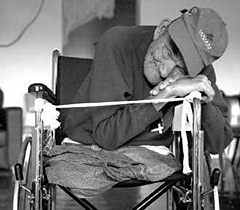
| | Manuel Espinosa rests in the warmth of the afternoon sun coming in through a window at La Divina Providencia. (Courtney Sargent/Cronkite News Service) | | |
Agua Prieta, Mexico - Grandmothers and grandfathers, nanas y tatas, are often left behind when family members illegally cross into the United States.
The elderly can't make the harsh and dangerous trip across the desert, and with tighter border enforcement, it's hard for families to return for visits.
The result: senior citizens' homes all along the Mexican border, filled with elderly residents, many of them long forgotten.
"The young people of this country leave their elderly family members here while they try to make it into the U.S.," said La Divina Coordinator Rosa Tarazon. "Abandoned people are becoming more and more common along the border."
"There are hundreds of people faced with this ugly situation," added Adalberto Ramos, head of the Centro de Recursos Migrantes, a help center for migrants. He said he has talked to dozens of people who have left their elderly family members behind because of increasing border enforcement and dangerous conditions.
They leave them in places like La Divina Providencia in Agua Prieta, Mexico, a home for seniors run by the Catholic Church and the Mexican government. The home is minutes from the Arizona border, but a world away from those who have crossed.
It is place of sorrow - and sometimes of hope. It is, most of all, a place of waiting.
One elderly resident breaks down sobbing each day. Another prays the rosary until the beads are worn. Another says she is trying to forgive her children and grandchildren who abandoned her. These are the forgotten faces of immigration, a generation abandoned.
Carmelita Gutierrez
Carmelita Gutierrez is 92 and has spent the last seven years in La Divina without once having a visitor.
She hasn't spoken to anyone in her family since her son Alberto died seven years ago in a car accident. She says she doesn't know how to get in touch with the rest of her family in the United States.
Communicating across the border is extremely difficult for these poor immigrant families, according to Jose Herrera, a minister in Douglas. "You have no idea how many people get separated from each other, lost in limbo," he said.
Gutierrez lives half in this world and half in a world she has created in her mind, one in which her son is still alive. Sometimes she's back in Guadalajara, starting her family.
"Carmelita believes she is going to go away with a soldier, start a new family and have her son Alberto pick her up from here in his truck. She'd rather not remember the truth, just illusions," said Elena Navarro, a caretaker at La Divina.
Gutierrez' life has been filled with family divisions and separation. When she was 9, her mother left her and her brother Jesus with their grandmother to go to the United States and work. Gutierrez' only memory of her mother is a basket her mother sent her 83 years ago for her first communion. Tucked inside were a little white dress and shoes.
After her grandmother died, Jesus went to look for their mother, and Gutierrez was left alone to work in the coffee fields. "That was the last time I saw my brother," she said with a tear rolling down her face.
She reached behind her back and picked up two teddy bears. "This is Alberto," she said, holding up the bear, squeezing him, then picking up the other. "And this is Jesus."
Emma Ortiz
Emma Ortiz caresses a picture of a pretty young girl in a white quinceañera dress.
This is her niece Ballida who she hasn't seen or heard from in 15 years. Emma has not talked to anyone in her family since they drove away from La Divina on Jan. 24, 1992, leaving her behind. "My family doesn't write me. I don't get any letters, and we never talk," she said. All she knows is that they were planning on moving to Phoenix.
Ortiz is left to imagine the life her loved ones now have - and to imagine the reasons they have remained away so long.
"I'm sure Ballida's never visited because she has a family and a husband in the U.S.," Ortiz said, looking down again at the picture. "I guess there's no reason to talk with them; it must mean everything is good."
She stops often to cough and gasp for air. Sometimes she uses a respiratory machine to ease the choking. Ortiz has had problems breathing since she was a young girl, her caretaker Elena Navarro said.
In recent years, problems with her thorax and trachea have worsened, and doctors can't do much to help except give her medicine to ease the pain.
"She's a beautiful person, so caring even though she could be bitter from all her health problems and her family abandoning her," said La Divina Coordinator Rosa Tarazon. "She suffers a lot." Ortiz smiles as Tarazon says this and spreads several rosaries across her chest. She explains that she is not angry because she talks to God and he listens.
"This rosary is for my family wherever they are," she said. "This one is for myself, and this one...this one is just for God." She would like her family in Phoenix to know that she hopes they will come. "They would be well received here," she said.
Isidra Seneth Zorilla Montoya
Isidra Montoya, 82, reaches out a frail hand each time a visitor passes her bed, but in the three years she's been here, no visitor has come to hold it.
Montoya's family - two sons and her favorite, daughter, Agostina - once lived in a small town in southern Mexico. The family made plans to cross illegally into the United States, but Montoya, then 78, was too weak to make the journey.
"The last time I talked to my daughter, she was getting married to an American. She was only going to leave me for a short time until she could come back and forth across the border legally," Montoya said.
Weeks turned into months and, finally, Montoya decided to search for her family. She got a visitor's visa and made her way to Douglas, but the address her daughter had given her was wrong. "I had no choice but to turn around; I gave up on them like they gave up on me," Montoya said.
Now she struggles alone against her ailing body.
A year ago she had all of her teeth pulled out and was left with a painful, blistering infection in her jaw. The only remedy was surgery, but she can't afford the operation.
"It's been a year and they haven't done anything; my jaw hurts so much I can't eat - only this mush," she said, holding up a watery gruel.
Montoya hardly leaves her bed and only speaks aloud to say her rosary. "She's depressed because she misses her family," said her nurse, Maria Santiesteban.
Sometimes Montoya thinks about what she would do if her family came back. "I would say nothing," she concludes. "They don't come here. They don't love me. They brought me over here and abandoned me."
Manuel Espinosa
Manuel Espinosa has been at La Divina for seven years.
All that staff members know about him is that they really don't know anything at all. No one saw who dropped him off at the senior care center on Oct. 11, 2000, and no one has come to see him since.
His legs were amputated, he cannot speak and he is deaf. "All we know is this piece of paper," said La Divina Coordinator Rosa Tarazon, holding up a sheet with his name, date of birth and medical problems.
Most of the time, he sits in the hallways or the TV room, alone, with a cowboy hat pulled low across his forehead.
Like Espinosa, many of the residents at La Divina are a mystery. They lose their memories, their hearing and their ability to speak.
Without their children and grandchildren, their stories are lost.
Raul San
Raul San rarely leaves his favorite chair that faces a window at La Divina Providencia. He is a father of two, a grandfather of many and a well-known presence in Agua Prieta, Mexico. He was born and raised in Agua Prieta and spent his life working as a plumber and political volunteer for the National Action Party of Mexico. "He was a hard worker and very good at his job," said caretaker Javier Morales Ortega. "People knew him here in Mexico."
San smiles as Morales says this. "You can see pictures of me in the newspapers," he said.
Those newspaper clippings have faded since his family left him in Mexico and moved to Los Angeles.
They used to come to visit about once a year, but as it has become more difficult to cross the border, they come less and less frequently. It has been more than a year since he has seen his daughter, and he fumbles with her name.
"I talk to them very little," he said. "I can't believe I am forgetting my own daughter's name."
Finally, he remembers it's Veronica and that she is as beautiful as her mother, who passed away many years ago. His fondest hope is that Veronica and his son will move to Arizona to be closer to him. "They're going to come and live in Douglas; they can't like Los Angeles. It's better here in Douglas by me," he said.
"It's hard to say you miss them because it makes it real," he added. "But I do, I miss everything about them. Not having them near is what I miss the most."
San knows he is one of the lucky ones: his family still sends money to cover medical bills, but he would rather have them close at hand.
"They want to be with me, but they can't. There they live," he said, pointing in the direction he imagines the border lies. "There they got married, and there they stay."
Editor's note: This story is the last part of a series on "Divided Families," an in-depth reporting project by advanced students in Arizona State University's Walter Cronkite School of Journalism and Mass Communication, supported by a grant from the Howard G. Buffett Foundation, the Illinois-based non-profit organization founded by the international photojournalist, author, environmentalist and philanthropist.
It is the second time that Buffett, who has said it's important for journalism students to explore countries beyond their own borders, has supported a Cronkite School student journalism project.
In 2006 his foundation underwrote the "Children of the Borderlands" project in which students produced photo documentaries depicting the lives of children along the U.S.-Mexico border.
Participating in the "Divided Families" project gave students "the opportunity to see border issues first hand and share stories about the lives of people directly affected by immigration policies," said one of the photojournalism students in the project, Courtney Sargent. "The importance of covering immigration issues became clearly evident after seeing the dichotomy between the two sides of the border." The line drawn between Mexico and the United States has always meant divisions that go far beyond geography or nationality. For many years, families have lost loved ones to distance and the desert, to the pull of new lives and the rejection of old ones.
This is more true now than ever. As it has become more difficult to cross the border - legally or illegally - it has become increasingly difficult for families to stay together.
It was with this in mind that a group of advanced journalism students set out to do a semester-long reporting project in fall 2007. Seventeen students - reporters, videographers and photographers - made more than 30 trips to the border, deep into Mexico and to various parts of Arizona to find and tell the stories of divided families. |
| |
|


 Vallarta Weddings
 Tell a Friend
 Site Map
 Print this Page
 Email Us