
|
|
|
 Editorials | Issues | May 2008 Editorials | Issues | May 2008 
Recent Developments in Mexico's Drug War
 Mica Rosenberg & Mariano Castillo - Reuters Mica Rosenberg & Mariano Castillo - Reuters
go to original
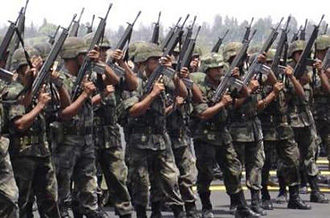
| | Soldiers prepare to board a military plane that will deploy them to Culiacan, northwestern Mexico, at a local airport in Tehuacan, May 13, 2008. Violence has exploded in Mexico's drug smuggling heartland in a three-way battle between rival gangs and security forces, the biggest challenge yet to President Felipe Calderon's war against the cartels. (Reuters/Mica Rosenberg) | | |
Here are some of the latest developments in Mexico's war with violent drug cartels, which produce and transport drugs across the border into the United States.
• President Felipe Calderon has deployed some 25,000 troops to attack the drug cartels since taking office in 2006, but the frontal campaign has failed to curb the violence, with some 1,300 people killed in drug related murders so far this year.
• Powerful cartels have recently shown their reach with high profile attacks, including the well-coordinated murder in Mexico City this month of Edgar Millan, a senior federal police chief in charge of drug investigations.
• The explosion in drug violence in recent years stems in part from a war over territory and routes between two main rivals: the Gulf cartel based near the border with Texas and an alliance of drug lords from the Pacific state of Sinaloa. Both employ squads of killers, known to torture and behead their victims, sometimes pinning notes to the bodies as a message to their enemies.
• To help Calderon in his drug fight, U.S. President George W. Bush agreed to a three-year $1.4 billion aid package providing aircraft, equipment and training to Mexico's government. Worried about corruption and army rights abuses, the Democratic-controlled U.S. Congress is expected to trim the $500 million in aid planned for this year.
• Mexican police have made several huge drug hauls and high level captures in recent months, and U.S. officials say those successes have sent the street price for cocaine higher. Mexican police last year found $206 million in cash hidden in drawers, suitcases and closets in the house of a smuggler importing chemicals used to make methamphetamine.
• In November, police found 23.5 tonnes of cocaine hidden in a shipment of plastic floor covering, Mexico's biggest ever drugs seizure.
• Osiel Cardenas, the notorious leader of the powerful Gulf cartel, was extradited to the United States last year.
• The U.S. government says drug proceeds earned by Mexican cartels selling cocaine, heroin, marijuana and methamphetamine in 2005 ranged from between $8 billion and $23 billion. Cocaine is shipped to Mexico from Colombia and other South American countries in speedboats, small planes and in one case a jumbo jet, all coordinated with state-of-the art technology and communications to move the cargo north by sea, air and land.
• The drug cartels also grow marijuana in the United States and produce methamphetamine in heavily guarded clandestine labs scattered across the Mexican countryside.
(Editing by Kieran Murray) |
| |
|


 Vallarta Weddings
 Tell a Friend
 Site Map
 Print this Page
 Email Us