
| | |  Editorials | Issues | November 2008 Editorials | Issues | November 2008 
North America Contributes to Root Causes of Food Crisis, Says Forum
 Marites N. Sison - Anglican Journal Marites N. Sison - Anglican Journal
go to original
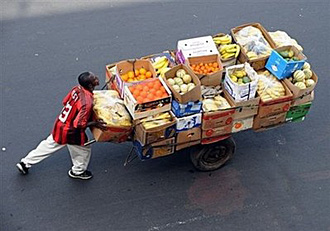
| | A fruit seller wheels his wares in Dakar, Senegal in May 2008. Despite predicted record crops in West Africa the region is still heavily effected by the food crisis because people cannot afford the available food, Oxfam and Save the Children warned Wednesday. (AFP/Georges Gobet) | | |
Tony Tujan, co-ordinator of the Asia Pacific Research Network of the Manila-based IBON Foundation, explains how the growth of agri-business in Asia-Pacific has given rise to “corporate feudalism.”
Did you know that the same amount of corn that produces enough ethanol to fill the fuel tank of an SUV would feed a Mexican for a year?
Or that the price of tortillas, Mexico’s staple food, has tripled and even quadrupled in some parts of that country because the price of white corn, which is indexed to the international price of yellow corn used for ethanol production, has risen dramatically?
In other words, there are people around the world who are starving because more and more land is being dedicated to cash-rich fuel crops like corn instead of food.
These were some of the points raised at a recent forum, Connecting the dots on the food crisis, sponsored by Kairos, the Canadian ecumenical justice organization, of which the Anglican Church of Canada is a member. The forum explored the root causes of the food crisis in the Global South, including the push for agro-fuels in rich countries like Canada and the U.S., the decades-long liberalization policies of governments, and the growth of agri-business transnational corporations.
John Dillon, program co-ordinator of Kairos, talked about how large-scale agro-fuel production for export has not only given way to hunger but also to exploitation of farmers who work in “slave-like conditions” in plantations, most of which are owned by trans-national corporations that enter into joint ventures with local landlords. (For example, since the U.S. cannot supply all the demand for corn ethanol, agri-business corporations have been importing agro-fuels from Asia, Latin America, and Africa.)
He cited the case of Brazil, which pioneered the production of sugarcane for ethanol and whose success rode on the backs of people displaced from their lands and on workers, some of them children, who are forced to work long hours under oppressive conditions.
Tony Tujan, co-ordinator of the Asia Pacific Research Network of the Manila-based IBON Foundation, discussed how the growth of agri-business in Asia-Pacific has given rise to “corporate feudalism.” He described the set-up as “semi-feudal;” in the absence of market rules, “farmers bear the brunt of the risks or failures.” He cited how, during the Japanese recession in 2001, export food products like asparagus were simply downgraded using the flimsiest of reasons (e.g. the tip wasn’t the right size) and farmers ended up with huge debts to transnational corporations.
Mr. Tujan also said that agri-business has allowed big corporations to speculate on the price of food.
Fr. Omar Fernandez, a priest from Colombia, talked about how ancestral lands have been forcibly taken away from indigenous Colombians for the production of palm oil, another source of agro-fuel. “The economic model that is being pushed takes people away from the land. People are dying of hunger,” said Fr. Fernandez, executive secretary of the Inter-Franciscan Commission of Justice, Peace and Care for Creation. Just as he was visiting Toronto on Nov. 17, he said that about 20,000 Colombians representing a coalition of farmers, indigenous groups, unions, women’s groups and church representatives staged a rally in Bogota to protest policies that have threatened people’s livelihoods and given rise to massive human rights violations.
Mr. Dillon said mono-crop cultivation for agro-fuel has also led to deforestation, soil degradation, loss of biodiversity and contamination of water supplies.
Ethanol was supposed to have been a better, cleaner fuel, but studies have shown that its production actually accelerates climate change. “While burning ethanol produces about 12 per cent to 13 per cent less greenhouse gases than petroleum, it is not a ‘clean’ fuel since it also emits carcinogens and increases atmospheric ozone,” said Mr. Dillon in a briefing paper published in 2007 where he cited a study conducted by the U.K.-based Institute of Science in Society. For instance, sugarcane is burned before harvest or forests are burned in order to clear it for palm oil plantations, causing a massive release of CO2 into the atmosphere.
With ethanol increasingly getting a bad reputation, many corporations are now looking for the next big fix, said Mr. Dillon, adding that cellulose is now being touted as an alternative. Mr. Dillon said groups like Kairos prefer to push governments to push in the direction of energy conservation and efficiency, and a re-examination of the pattern of consumption in the West.
“A study by the U.S. Congressional Budget Office found that reducing gasoline consumption by 10 per cent through an increase in fuel economy standards would cost consumers and industry about U.S. $3.6 billion a year,” said Mr. Dillon in his paper, Are agrofuels alternatives to oil? “To replace the same amount of gasoline by producing more ethanol would cost over US$10 billion in government subsidies.” |
|
| |


 Vallarta Weddings
 Tell a Friend
 Site Map
 Print this Page
 Email Us