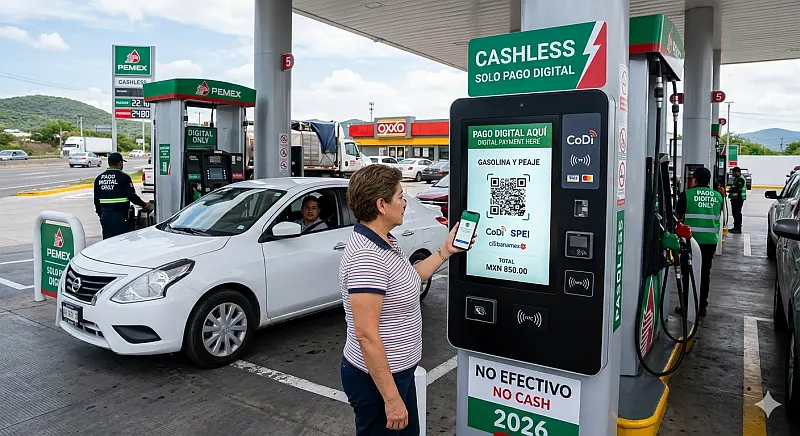
Mexico is steering toward a cashless future on its highways and at the pump. During the 89th Banking Convention in Cancun, President Claudia Sheinbaum announced a sweeping digital mandate for 2026 that will require all fuel and road toll payments to be handled electronically.
This policy marks a major shift for a country where cash still accounts for 80% of transactions in these sectors. By moving away from physical currency, the federal government aims to modernize the national economy and significantly reduce wait times for drivers. The initiative is a joint effort between the Executive Branch, the Bank of Mexico (Banxico), and the Association of Mexican Banks (ABM).
A central piece of this transition is the CoDi (Digital Payment) platform. Developed by Banxico, CoDi allows users to make instant transfers using QR codes or mobile technology without carrying a wallet. To encourage its use, officials confirmed that these transactions will carry zero commissions for both the customer and the business owner.
Financial institutions are also introducing incentives to speed up the process. The ABM has proposed a temporary waiver on interchange fees for card payments at gas stations, which would lower operating costs for station owners. Furthermore, the Banco del Bienestar is undergoing its own digital upgrade to ensure that citizens receiving social vouchers can easily pay for these essential services through electronic means.
The push for digitalization is being managed by the newly formed Digital Transformation Agency. This agency is tasked with cutting through all of the red tape and unifying the permits needed to install digital payment infrastructure across the country. President Sheinbaum noted that simplifying these administrative hurdles is key to attracting the necessary investment to make the system nationwide.
While the goal is to make digital payments the standard throughout 2026, the government has not yet set a specific date for when cash will be officially restricted or when penalties might begin. For now, the focus remains on a gradual rollout, giving the public and gas station operators time to adapt to the new platforms.
If this transition proves successful, the model could soon expand. Banking leaders suggest that once digital payments are the norm for travel and fuel, the same system could be used to collect government fees and taxes at every level of the administration. This move represents one of the most ambitious steps toward financial inclusion in Mexico’s recent history, aiming for a more secure and efficient experience for everyone on the road.

We Need Your Support: While other local media outlets have retreated behind paywalls, at Banderas News, we believe news should be free for everyone. Would you help us provide essential information to our readers at no cost? We can’t do it without you. Your contribution helps us sustain and grow.