
Mexicali, Mexico – Conservation organizations are taking the Mexican government to court in a high-stakes effort to save the world’s most endangered marine mammal.
The Center for Biological Diversity, Comarino, and Greenpeace México have filed a constitutional challenge against newly enacted fishing rules in the Upper Gulf of California. The groups argue that the government’s October 14, 2026, regulations dangerously roll back vital protections for the vaquita, a tiny porpoise hovering on the absolute brink of extinction with only about 10 individuals left on Earth.
The heart of the lawsuit centers on a massive 86% reduction of the sanctuary zone where deadly gillnets are banned compared to rules set in 2020. This change strips safety measures from thousands of square kilometers of the porpoise’s historic waters.
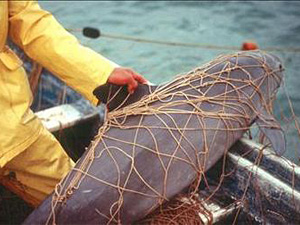
Vaquitas do not target fishing gear, but they frequently become tangled in the fine mesh of gillnets set for shrimp and totoaba – an endangered fish whose swim bladder commands high prices on the Asian black market. Trapped underwater, the air-breathing mammals quickly drown.
Activists say that the government pushed these sweeping changes through without giving citizens or scientific experts a fair chance to weigh in.
“The government made a decision with potentially catastrophic consequences for the vaquita without giving the public a chance to examine the proposed boundaries and respond,” said Alex Olivera, Mexico representative at the Center for Biological Diversity. “With only about 10 of these little porpoises left, Mexico should be enforcing rules in the vaquita’s entire habitat, not legalizing gillnets in waters that should be protected.”
The lawsuit contends that skipping public consultation violates Mexico’s legal obligations under the Escazú Agreement, an international treaty guaranteeing transparent public participation in environmental policies.
Beyond shrinking the overall protected area, the revised policy carves a 350-meter-wide vessel transit corridor directly through the middle of the “Zero Tolerance Area,” an inner sanctuary where all boat traffic and fishing were previously banned. Scientific consultants point out that dividing this habitat creates dangerous fragmentation. Furthermore, the new rules delay mandatory satellite tracking systems on fishing vessels for up to a year, tying the requirement to future budget approvals.
These regulatory rollbacks stand in sharp contrast to recent scientific advice. Researchers from the International Committee for the Recovery of the Vaquita (CIRVA) explicitly urged Mexican officials to expand protections to the northwest, where vaquitas were sighted in both 2025 and 2026. Experts recommended placing heavy concrete blocks with net-hooking rebar in those northwest waters to deter illegal fishing – a measure successfully deployed in other parts of the sanctuary – but the area remains unblocked and unprotected.
Ilse Vázquez Maldonado, a lawyer and activist involved in the case, noted that the state has struggled for over six years to enforce existing net bans or monitor local fleets. She warned that pairing chronic lack of enforcement with smaller protected zones places full responsibility for the species’ potential extinction on the Mexican state.
While environmentalists push for an immediate suspension of the regulations while the court reviews the case, they emphasize that saving the vaquita requires supporting human communities as well.
“Fishing communities need long-term sustainable livelihoods and fishing methods that are safe for vaquitas,” said Aleira Lara, executive director of Greenpeace México. She stressed that economic justice for local fishers and species conservation do not have to be mutually exclusive, provided the government invests in alternative, safe fishing gear.
The conservation groups hope the court acts quickly to freeze the new rules before gillnets return to the vaquita’s shrinking home.

We need your support to keep Banderas News thriving. As more and more news outlets resort to paywalls, we remain steadfast in our mission to provide free, quality journalism to Puerto Vallarta residents and visitors. Your contribution helps us maintain this commitment and continue serving our community.