Mexico’s Ministry of Environment and Natural Resources (SEMARNAT) has presented a proposal to replace the country’s 1988 General Law of Ecological Balance and Environmental Protection (LGEEPA), updating the legal framework for today’s environmental challenges.
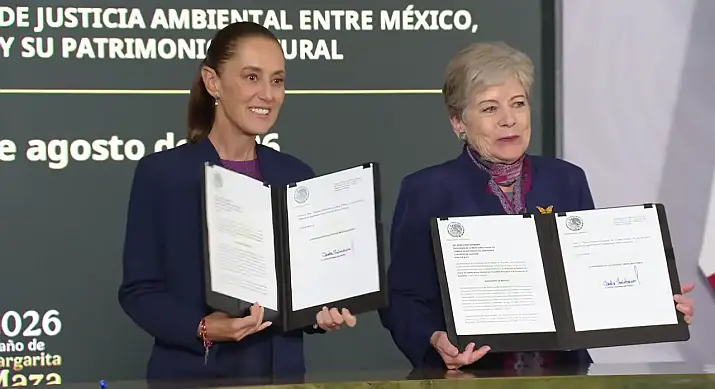
Environment Minister Alicia Bárcena presented the initiative during President Claudia Sheinbaum’s morning press conference, describing it as a shift toward greater environmental justice and a closer relationship between economic development and nature.
The proposed law would move environmental policy away from a system that often responds to damage after it occurs and toward prevention, restoration, and remediation. Major industrial and infrastructure projects would be subject to strategic environmental evaluations designed to consider their broader regional impact rather than assessing projects in isolation.
The initiative also seeks to provide clearer rules for communities, businesses, and government agencies. It would establish formal mechanisms for ecological restoration, climate change adaptation, and environmental damage remediation, while clarifying responsibilities among federal, state, and municipal authorities.
A major change would be the incorporation of the Escazú Agreement into Mexican law. This would strengthen public access to environmental information, citizen participation in decisions affecting land and natural resources, and access to environmental justice. The proposal also includes protections for environmental defenders.
Communities would have a more central role in conservation under the proposed framework, particularly Indigenous and Afromexican communities. Scientific research, technology, digital monitoring, and traditional knowledge would be brought together through specialized working groups coordinated with the Ministry of Science, Humanities, Technology, and Innovation.
The legislation also promotes a shift from a disposable, linear economy toward a circular model focused on reuse, resource efficiency, recycling, and waste recovery. It includes measures to reduce municipal waste, expand recycling infrastructure, and strengthen protections for coastal ecosystems and mangroves.
Bárcena said the proposal reinforces Mexico’s constitutional right to a healthy environment and recognizes natural resources as essential infrastructure for the country’s long-term prosperity. The framework also includes efforts to restore native species such as the Mexican wolf, California condor, blue whale, and dolphins.
The proposed reform would address longstanding environmental contamination in areas including the Endhó Dam and Sonora River basin. It also complements SEMARNAT’s broader cleanup efforts, including a MX$20 billion program targeting pollution and sanitation problems in the Tula, Atoyac, and Lerma-Santiago rivers.
The changes would give Mexico a more preventive and community-focused approach to environmental protection. SEMARNAT says the goal is to ensure economic development does not come at the expense of ecosystems, while creating clearer rules for businesses, governments, and communities to protect the country’s natural heritage for future generations.

We Need Your Support: In a world where information is increasingly locked behind paywalls, Banderas News remains committed to providing essential news and information to Puerto Vallarta residents and visitors, free of charge. Your support ensures we can continue delivering the stories that matter most to you. By contributing, you’re not just supporting a news outlet; you’re safeguarding the right to an informed community. Your contribution helps us sustain and grow.