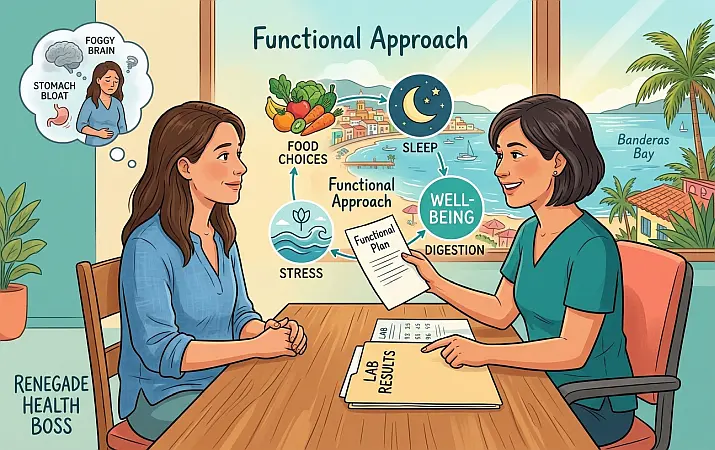
Puerto Vallarta, Mexico – You’re tired. Your stomach is bloated. Your brain feels foggy, and your patience is wearing thin. You go looking for answers, only to hear, “Your labs look normal.”
That should feel like good news. But when you still feel awful, it can leave you wondering what to do next. If everything looks fine, why don’t you feel fine?
Lab tests are useful, but they do not tell your whole story. Your symptoms, food choices, sleep, stress, and daily habits matter, too. This is where a functional approach can help bring the bigger picture into focus.
What Is Functional Medicine?
Functional medicine asks a simple question: What might be contributing to the way you feel?
It looks at how your body’s systems work together and how your health history and daily life may affect them. A practitioner may explore what you eat, how you sleep, your digestion, your stress, and when your symptoms first began. The goal is to build a plan around you as a person.
Imagine a plant with yellow leaves. You could focus on the leaves, but you would also want to check the soil, water, and sunlight. Your body is more complex than a plant, but the question is similar: What does it need, and what might be getting in the way?

“Normal” Does Not Tell the Whole Story
A lab’s reference range helps a clinician make sense of a result. It is not a complete measure of how well you feel or function. A result within range does not rule out every health problem, and a result outside it does not always mean disease.
Some functional practitioners use narrower target ranges when reviewing results. These are often called “functional” or “optimal” ranges. They can differ between practitioners and are not agreed upon for every test. The key is to connect the numbers with your symptoms and medical history, rather than chase a number alone.
Vitamin D is one example. You may see different ranges on lab reports or hear different targets from providers. The units matter, too: ng/mL and nmol/L are not the same. There is no single agreed-upon functional target, and higher levels are not always better. A useful discussion includes your test result, your health needs, and whether supplements and follow-up testing make sense.
Testing can help identify disease, while a functional approach places added focus on how you function day to day. Those goals can work together. We want you living well, not feeling as though you are barely surviving.
What Does This Look Like in Real Life?
Consider someone who feels tired every afternoon. Looking at a lab report is one step. Asking whether they skip lunch, sleep poorly, or rely on coffee to get through the day adds useful clues. A medical evaluation may also be needed to check for causes such as anemia or a sleep disorder. The plan should follow what is found.
For someone with bloating, the conversation might include bowel habits, meal timing, food patterns, and medicines or supplements. A food and symptom diary may help show patterns. Testing should answer a clear question, rather than assuming everyone needs the same panel or a strict diet.
For someone who feels stressed and short-tempered, support may include a steadier sleep routine, regular meals, movement, and ways to calm down during a hard day. These steps do not explain every emotional concern, but they give daily habits a place in the conversation.
The point is to match support to the person, then check whether it helps.
Why This Work Is Personal to Me
I spent more than 27 years searching for answers to health problems that the conventional care I received had not resolved. I was later diagnosed with Lyme disease and three autoimmune diseases. I know how hard it is to keep asking for help when you are exhausted and unsure whether things will ever change.
In my own journey, those conditions went into remission after a combination of functional medicine care, lifestyle changes, and stress management. That experience led me to become a Functional Diagnostic Nutrition Practitioner. It also gave me a deep respect for people who are still searching for an answer.
My story does not mean everyone will have the same results. It means I understand why hope matters—and why hope needs practical steps behind it.
A Place for Both Approaches
Modern medicine can be lifesaving after a car accident, during surgery, or in a medical crisis. It also plays an important role in chronic illness and prevention. I value that care.
For ongoing health concerns, I believe a functional approach deserves a place alongside it. There is value in taking time to explore food, sleep, stress, and daily life, as well as test results. You should not have to choose between needed medical treatment and support for the habits that shape your health.
You Deserve to Feel Heard
Living with symptoms can make your world feel smaller. You may stop making plans or begin to accept that feeling unwell is simply your new normal. But there may still be useful questions to ask and steps worth exploring.
As The Renegade Health Boss, I help people look at the bigger picture and build realistic changes that support their health. My goal is to help you feel informed, supported, and more able to take part in the life you want.
To learn about working with me, visit RenegadeHealthBoss.com.
Your lab results are part of your story. How you feel deserves attention, too.

Have a Healthy day!
Heather
Heather Gray, FDN-P, is a master certified health practitioner, best-selling author, speaker, stand-up comedian, and host of the Renegade Health Boss podcast. A proud Puerto Vallarta resident, she shares her passion for health, resilience, and personal transformation while enjoying the adventure, community, and fresh perspective she found in Mexico.