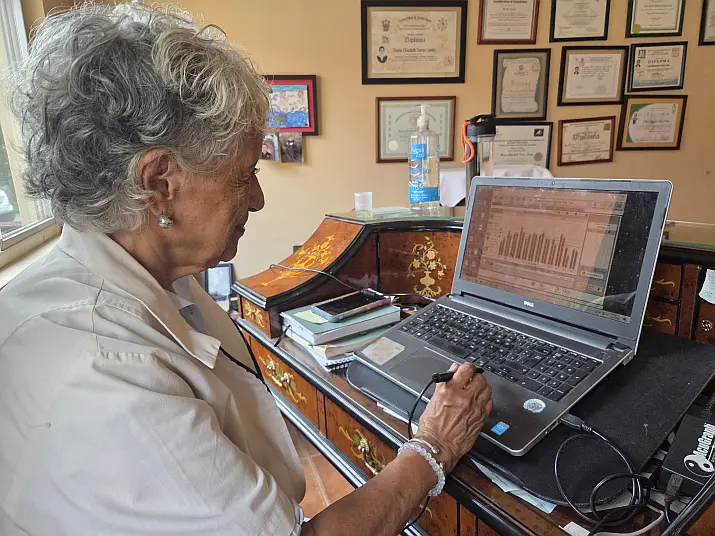
Puerto Vallarta, Mexico – If the thought of acupuncture immediately makes you picture dozens of needles sticking out of your body, Mari Torres may completely change the way you think about this ancient healing practice. Mari opened her clinic in Puerto Vallarta in the early 2000s, although becoming an acupuncturist wasn’t necessarily part of some grand lifelong plan.
When the University of Guadalajara offered an acupuncture program locally, a friend convinced Mari to enroll with her. Ironically, the friend who talked her into the program eventually left, while Mari stayed, completed her training and discovered a path that would become a major part of her life’s work. More than two decades later, she continues to practice in Puerto Vallarta, combining the traditional foundations of acupuncture with an impressive collection of modern technology.
Where Ancient Medicine Meets Modern Technology
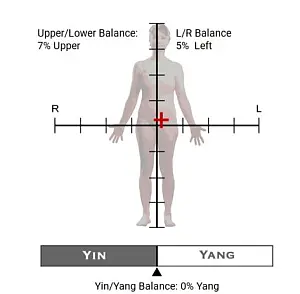
When I walked into Mari’s office and saw all of the technology she uses, I felt a little like I had stepped onto the set of an ’80s sci-fi movie. Between the beeping, booping, scanning and assortment of equipment surrounding me, the biohacker in me was immediately intrigued. Her practice may be rooted in acupuncture, but the experience was much more high-tech than I expected.
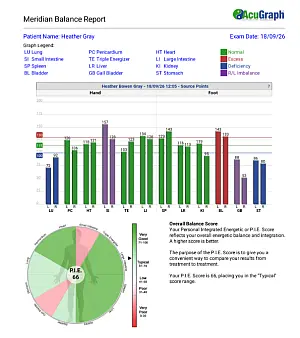
One of the tools that immediately caught my attention was the AcuGraph, a Digital Meridian Imaging system that measures electrical conductivity at specific acupuncture points, primarily on the hands and feet. The system takes measurements associated with the 12 primary acupuncture meridians on both sides of the body and translates that information into visual graphs. The practitioner can then look at patterns among the different meridians, including relatively higher or lower readings and differences between the left and right sides of the body.
Mari uses this information as another piece of the puzzle, combining what she sees on the AcuGraph with her training, observations and what the person sitting in front of her is experiencing. Rather than looking only at where someone is experiencing discomfort, the assessment gives her additional information that can help determine which acupuncture points she wants to work with. As someone who already works with bioenergetic technology, I found the process fascinating. There is something pretty incredible about watching a healing system that has been around for thousands of years meet computers, digital measurements and modern technology.
Acupuncture Without the Needles
The next part of my visit was especially interesting because I had never experienced laser acupuncture before. Instead of inserting a traditional acupuncture needle, laser acupuncture uses light to stimulate selected acupuncture points. If you are familiar with acupressure, the concept isn’t completely foreign. Acupuncture points can be stimulated in different ways, and Mari has incorporated technology that gives her another way of working with those points without necessarily using needles.
My experience with the laser was completely painless and noninvasive, and it immediately made me think about how many people have been curious about acupuncture but have avoided it simply because they are afraid of needles. The AcuGraph gives Mari information about the points she may want to work with, and the laser gives her another way to stimulate them. You could say it allows her to get pretty laser focused with a session, and yes, that pun was absolutely intended.
The technology didn’t stop there. During my visit, I happened to mention that I had been experiencing some knee pain, and Mari pulled out yet another piece of equipment to work on the area. Again, the experience was noninvasive and painless, and by the time I walked out of her office, my knee pain was gone. That was my personal experience, but it certainly got my attention and made me even more curious about all of the different tools she has incorporated into her practice.
When the Nervous System Needs a Little Help
My boyfriend also went in for a session. He recently lost his mother and has been moving through a tremendous amount of grief, which has also affected his sleep. He hasn’t been sleeping well, and we were hoping the session might help him relax and give his nervous system an opportunity to slow down a little.
I can’t tell you exactly what was happening physiologically during his treatment, but I can tell you that about halfway through the session, he was snoring on the table. Considering how difficult sleep has been for him lately, watching him relax that deeply certainly caught my attention.
Mari also sent him home with a flower-based remedy similar to Bach flower remedies to offer some additional support while he moves through the grieving process. I appreciated that she wasn’t looking at him as simply a collection of physical symptoms. She was paying attention to what he had been through emotionally, how he had been sleeping and how he was feeling overall. Grief doesn’t exist in a neat little box separate from the rest of our lives, and I appreciated seeing an approach that took the whole person into consideration.
A Biohacker’s Playground
As I looked around Mari’s office, I realized just how much technology she has accumulated over the years. Between magnetic therapy beds, Rife technology, lasers and bioenergetic assessment equipment, she basically has all of the toys a biohacker like me could want. I kept finding myself wondering what the next machine did and whether I could try that one too.
What impressed me most, though, wasn’t simply the amount of equipment in the room. It was seeing someone who has practiced for more than two decades continue to learn, evolve and incorporate new technology into a practice based on such an old healing tradition. Acupuncture has an incredibly long history, yet in Mari’s Puerto Vallarta office it exists comfortably alongside computers, lasers, digital graphs and bioenergetic technology.
I have never believed wellness has to be an either-or conversation. There can be value in traditional practices, value in newer technology and even more interesting possibilities when someone understands how to bring the two together.
Wellness Before Something Goes Wrong
I am particularly interested in these kinds of tools from a preventative wellness perspective. Too often, we wait until something hurts, our energy disappears or our bodies are practically screaming at us before we start paying attention. I would much rather become curious sooner. What patterns are beginning to show up? Where might the body need more support? What information can we gather now that might help us make better decisions about our health going forward?
Those questions can be valuable for someone struggling with chronic health concerns, but they can be equally valuable for someone who simply wants to understand their body better and become more proactive about their wellness.
What began in the early 2000s with a friend talking Mari Torres into taking an acupuncture course has turned into more than two decades of working with people here in Puerto Vallarta. The friend may not have stayed in the program, but fortunately for Vallarta, Mari did. After experiencing her approach myself, walking out with my knee feeling better and watching my sleep-deprived boyfriend become relaxed enough to start snoring in the middle of his treatment, I am really impressed with what I’ve experienced so far.
For anyone who has been curious about acupuncture but has spent years saying, “Absolutely not, I hate needles,” Mari’s approach may give you a reason to reconsider. Being afraid of needles doesn’t necessarily mean acupuncture has to be off the table. No pasa nada. Mari just might have a laser for that.

Have a Healthy day!
Heather
Heather Gray, FDN-P, is a master certified health practitioner, best-selling author, speaker, stand-up comedian, and host of the Renegade Health Boss podcast. A proud Puerto Vallarta resident, she shares her passion for health, resilience, and personal transformation while enjoying the adventure, community, and fresh perspective she found in Mexico.